


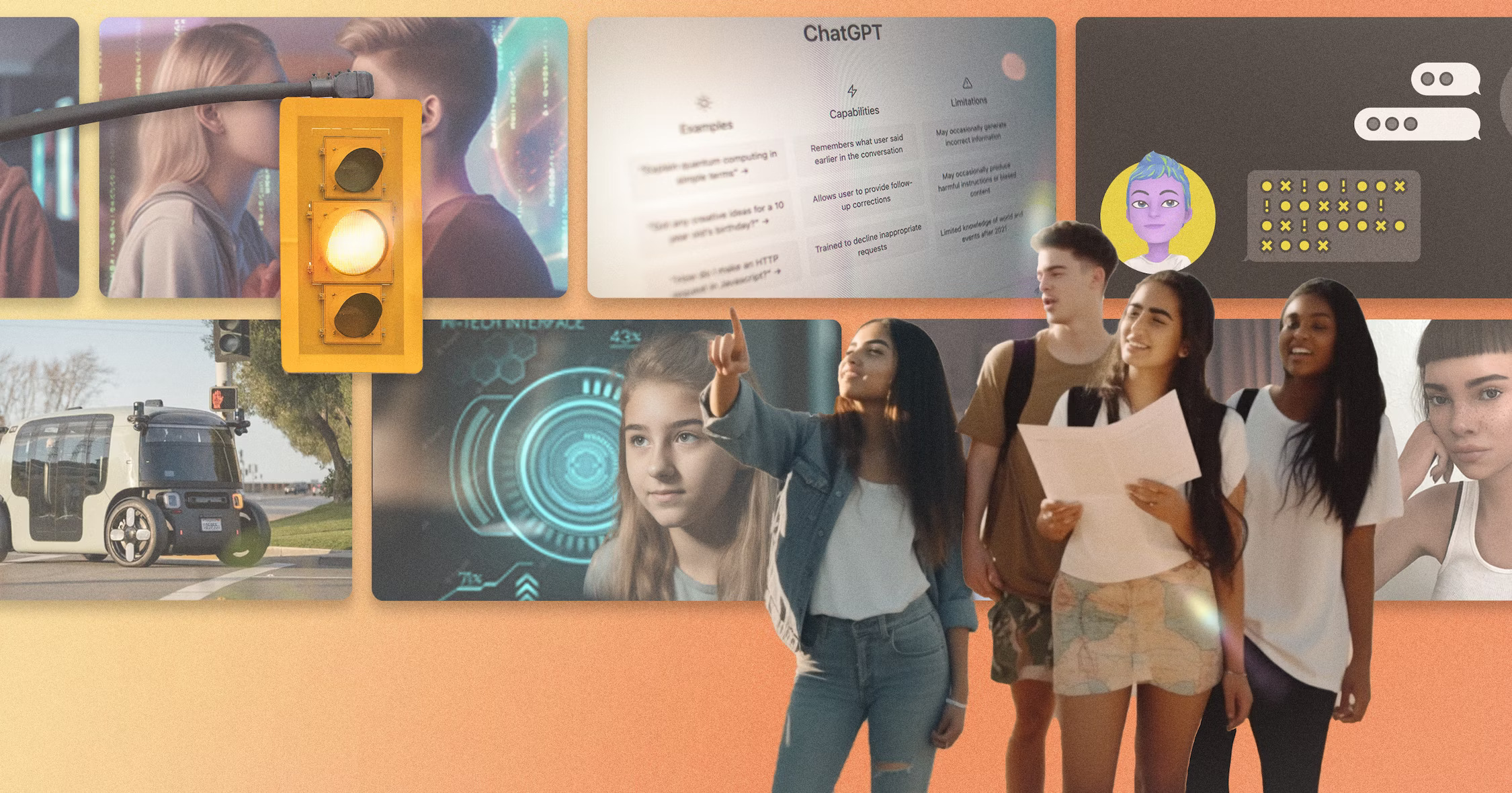
AI helped you with your final paper and made your workout plan—why not have it help resolve a conflict between you and your friends, or help you pick your career?
Because that’s where artificial intelligence crosses the line from innocuous to intrusive—at least for the group of 13- to 21-year-olds with whom we spoke. To better understand how the next generation will respond to a new wave of AI products, services, and experiences coming online, we prototyped hypothetical apps to elicit feedback. “AI Passion Coach” for one, is a guide that identifies your skills and makes suggestions for how and where to apply them. That didn’t go over so well. “I’m all for AI helping me find the most optimal way to learn once I know what my passion is,” a college freshman told us, “but finding a passion for me? Not so much.”
After sharing six concepts, we came away with some strong hunches about how this cohort wants to show up in the world—both in person and digitally. They’re not looking for products that can be creative for them, they want tools that help them be creative themselves—a subtle but important difference.
Just as digital maps have ruined our collective sense of direction, Gen Z fears that the generative AI’s shortcuts and automations may diminish their ability to form their own identity.