It's tempting to read the global rise of K-pop as a story about catchy songs and slick choreography. The truth is closer to industrial policy.
South Korea's pop music industry is one of the most successful exports of the last quarter century — a multibillion-dollar machine of choreography, fan platforms, multimedia content, and licensed merchandise. It is also the deliberate result of a national strategy that began with a financial crisis and ended with culture itself reframed as infrastructure.
Understanding how that happened — and what it became — is more than a music industry story. It's a window into how culture gets produced at scale, what it does for an economy, and why teenage girls turn out to be one of the most powerful cultural forces in the world.
> Teenage girls might be the most powerful cultural force in the world.
01Financial Origins
The 1997 Asian Financial Crisis hit South Korea hard. The collapse of Thailand's baht set off a regional contagion that ended with Korea taking a $58 billion IMF bailout — the largest in history at the time. The country needed new sources of foreign exchange, and fast.
When Kim Dae-jung was elected the country's first opposition president in 1998, he had a famously specific reference point: the export earnings of Jurassic Park. If a single film could earn what 1.5 million Hyundai cars exported, culture wasn't a luxury good. It was infrastructure. He ended a 50-year ban on Japanese media imports and set Korea on a course to manufacture its own.
02K-pop Takes the Stage!
The cultural conditions had been quietly stacking up. In 1996, Korea's Constitutional Court struck down the most restrictive provisions of state censorship. A few years earlier, Seo Taiji & Boys — performing "Come Back Home" in what one observer called "snowboarder chic" — had effectively detonated the polite Korean pop landscape. The genre we now call K-pop took shape in the gap between those two moments.
What followed was less a single act of cultural genius than a system: agencies, idol training programs, multimedia release strategies, and fan platforms designed to convert attention into long-term loyalty. By the time BTS debuted in 2013, the playbook was already three generations deep.
03Setting the blueprint
The blueprint was hard-won. Trainees signed multi-year contracts, learned to sing and dance and act and speak two or three languages, and shipped as members of carefully composed groups. Songs were structured for choreography first and lyrics second, with hooks designed to survive the loss of any one language on the way to a global audience.
It was a system optimized for export. And it worked: by the early 2010s, Korean pop had become a top-of-funnel for an entire creative economy that included TV, film, fashion, beauty, and food.
04Enter: The Schoolgirls

If the first generation of K-pop was led by boy groups, the second was reshaped by women — and the audiences that adored them. Park Ji-yoon's "Coming of Age Ceremony" (2000) pushed against the "innocent girl" archetype that had defined Korean pop for a decade. 2NE1's debut track "Fire" (2009) introduced the "girl crush" — a stance that was as much a marketing posture as a musical one.
By the time BLACKPINK arrived, the model had been perfected. Their July release "JUMP" sat on top of streaming charts simultaneously in markets that, fifteen years earlier, had no shared cultural reference points at all.
05Culture as Economy
Sanrio, the Japanese licensor behind Hello Kitty, has at points ranked as the world's eighth-largest licensor — ahead of Nintendo, Playboy, and the NFL. That stat is a useful reminder that what looks like "culture" from one angle is, from another, a balance sheet of intellectual property, distribution rights, and recurring revenue.
Korea built its own version of that machine in record time. HYBE, the entertainment conglomerate that manages BTS, is now developing global groups like KATSEYE that aren't quite Korean and aren't quite American — they're K-pop in the same sense that hip-hop is now a global form rather than an American one.
06Sex and Evolution
Read Matt Alt's _Pure Invention_ on Japan's pop-culture dominance and you start to see a pattern: every successful cultural export has had to negotiate the body. Fashion magazines and music videos adjudicate — sometimes cynically, sometimes thoughtfully — what kinds of femininity are tradable across borders.
K-pop's recent generations have iterated on this question loudly and in public. The girl-crush stance, the schoolgirl reinvented, the explicit (and contested) sexuality of newer acts — all of them are arguments about who gets to shape culture and who gets to consume it.
07Back to the Demon Hunters
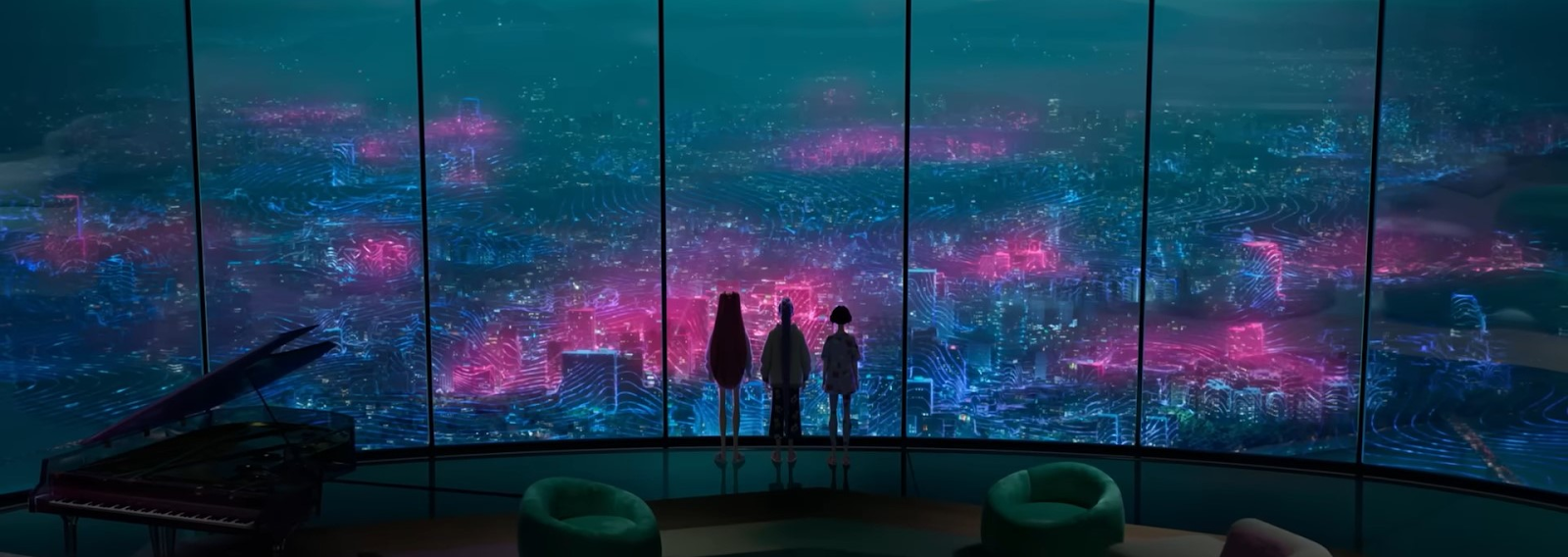
Which brings us back to KPop Demon Hunters, an animated film that — improbably and unmistakably — lives at the center of all of this. Its world is a synthesis of three decades of cultural infrastructure: a girl group with magical powers, a global aesthetic stitched out of Seoul, Los Angeles, and the internet, and a story whose emotional logic is the same one that powers BLACKPINK.
The film is fun. It's also evidence: of how thoroughly culture-as-production has reshaped the creative economy, and of why teenage girls — the audience that built the K-pop machine over twenty-five years — keep turning out to be the most powerful cultural force in the world.


 Edges
Edges