


It's 1973 and I'm in Pittsburgh, fixing up my van for a cross-country roadtrip to Seattle for my first job out of college at Boeing. I'm outside my apartment building, installing cabinets and putting in a fold-up bed before some guy walks by, looks at what I'm doing and says: "...you know there's a table saw in the design studio?"
To which I replied: "what's the design shop?" And then after I thought it about for a beat more, "what's design?"
I found the shop, and, to make a long story short, from that moment, I feel like the luckiest guy in the world.
The Speech
There's a set of well-worn cliches that get trod out every year around May and June when it comes time for the commencement speakers to stand and deliver a rousing speech to the next generation. You've probably heard them: "follow your passion," "live in the present," "never stop learning." They're not necessarily wrong, but they aren't all that interesting, either.
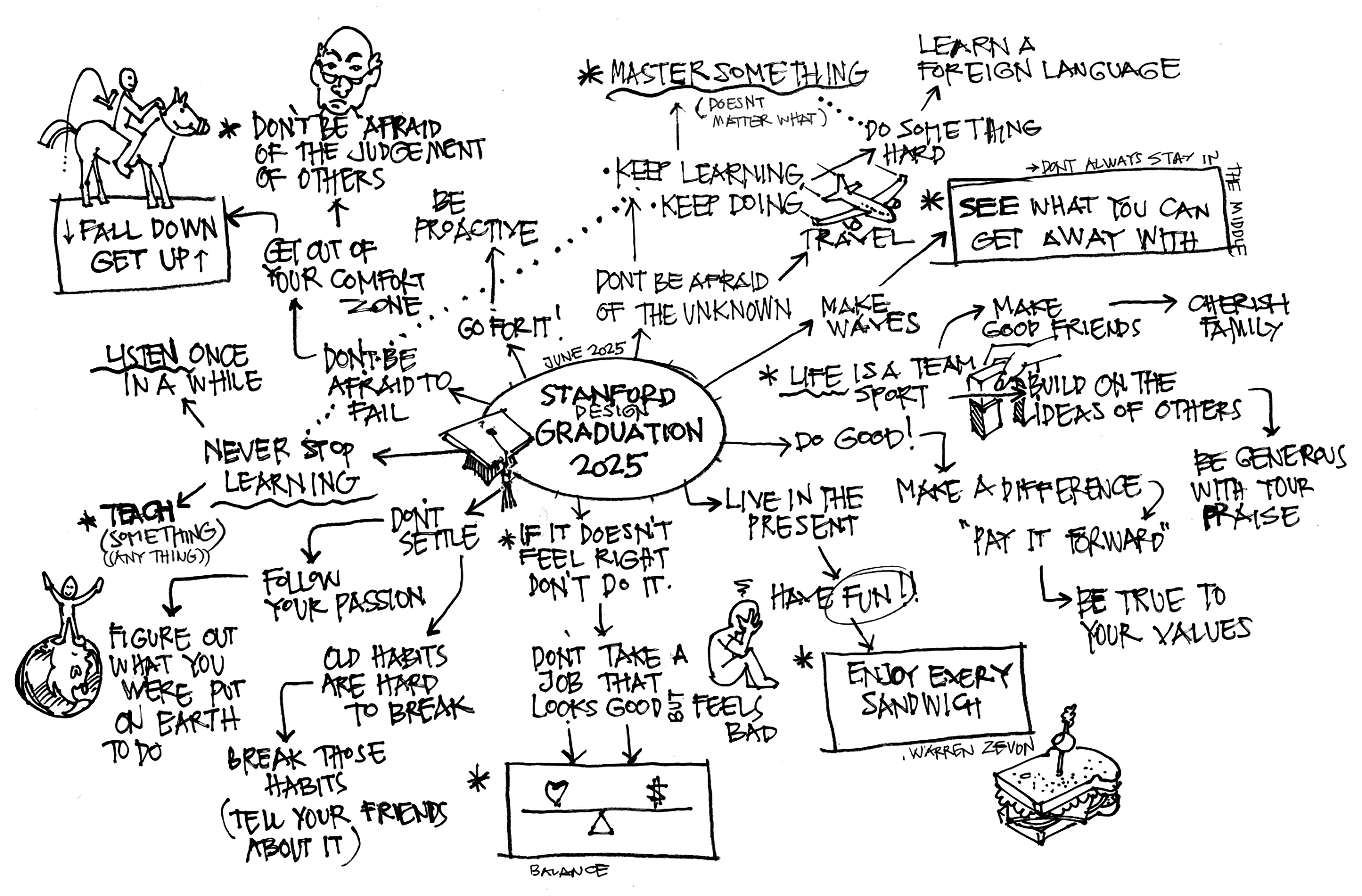
I gave a commencement speech to the 2025 graduating class of the Stanford d.School. The one thing I didn't want to do was to pontificate or talk down to the students about what they needed to do in the future. So, as has been my habit for a number of decades now, I began drawing. Drawing as a way to excise all of the things that fall under the category of "true, but boring" -- those aphorisms that indicate the wizened knowledge being passed down from on high.
But I wanted to write a speech that was weirder and more entertaining than that. I got my mind map down, put it under seats of the students (knowledge from down under, instead) and said what I wanted to say without the burden of trying to sound like I know everything.
Instead of "true, but boring," I wanted to do something else: "dubious, but interesting." Mischief breeds its own kind of truth. At least that's how I always operated.
The Future
I used to get asked questions when I was a young designer like "where do I get glasses like those?" or "what briefcase should I buy?" Besides being flattered for my discerning eye for fashion, there was a trend amongst businesses to treat design as purely aesthetic. Sprinkles on top of a cake.
That's changed. Now, we get questions from CEOs like "how can we redesign the school system in Peru?" Design has its seat at the table, fundamentally transforming in my lifetime from "make it look good" to "what are the biggest, trickiest problems we are facing and how can we use our role as designers to solve them?" That's a good thing. I wouldn't have bee in this industry for as long as I have if I didn't think design was a powerful force for good.
There are new shifts to come, of course. Human-centered design was never meant to be a static playbook. It has and will continue to evolve to new situations, new environments, new problems. These shifts will not be the result of the "true, but boring," but of the "dubious, but interesting." Certainty is the antithesis of creativity. And if there's one thing I do believe, it's that whatever the next generation will produce, they'll need to get creative. We have old answers. It's time for new questions.
The kind that might make you stop in your tracks one day while fixing up a van and say, "What are you talking about?"
Who knows, it might just change your life.